


Big relief for merchants ahead of the festive season. NPCI defers the implementation of MDR charges on UPI transactions till Diwali; new rollout date to be announced later
The National Payments Corporation of India (NPCI) announces a delay to the rollout of 0.4% Merchant Discount Rate (MDR) on Unified Payments Interface (UPI) transactions exceeding Rs. 2000. Earlier, the MDR implementation was scheduled for October 15.
According to NPCI’s latest press note, the UPI and Services Steering Committee has decided to implement the MDR on select Person-to-Merchant (P2M) UPI transactions immediately after Diwali. A specific date will be notified separately later.
This decision comes after considering the rise in UPI transactions and consumer spending during the festive season in India, which usually runs from October to December.
The postponement offers temporary relief to merchants, payment aggregators and fintech companies during one of the busiest shopping periods of the year. With Diwali approaching, businesses can continue accepting UPI payments without the proposed MDR charges taking effect before the festival.
The delay also gives stakeholders additional time to prepare for the revised fee structure and its implementation.
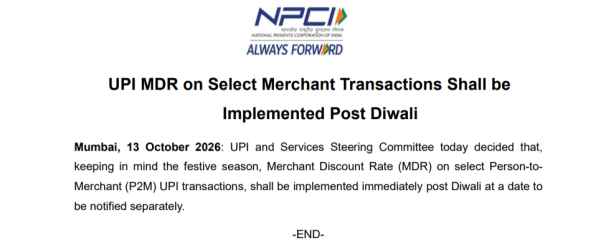
NPCI’s press note regarding the delayed implementation of UPI MDR
Why Has NPCI Delayed UPI MDR Charges?
The decision follows concerns raised by merchant associations, fintech firms and payment companies over the timing and operational challenges associated with introducing the new charges.
Merchants and business associations reportedly sought a postponement, citing the potential impact on festive-season sales, consumer sentiment and merchant costs.
According to an earlier report by MoneyControl, stakeholders raised concerns about differences in MDR rates and the applicability of charges across various UPI transactions. Implementing a revised fee structure across a large and diverse merchant network also presents operational challenges.
The festive season typically witnesses increased spending on electronics, clothing, jewellery, home appliances, and other consumer goods. Introducing additional payment-processing costs during this period could create uncertainty for businesses that depend heavily on digital transactions.
How Much Will the Proposed UPI MDR Charge Be?
The proposed Merchant Discount Rate is 0.4% on eligible UPI transactions exceeding Rs. 2,000. MDR is a fee associated with processing digital payments, generally borne by the merchant rather than directly charged to the customer.
For transactions of ₹75,000/- and above, the MDR will be capped at ₹300 per
transaction.
At the proposed rate, a merchant would incur a processing fee of Rs. 8 on an eligible transaction worth Rs. 2,000, or Rs. 40 on a transaction worth Rs. 10,000, before any applicable taxes or other adjustments.
The actual amount payable would depend on the final rules governing eligible transactions.
The charges are intended for select Person-to-Merchant (P2M) transactions, rather than every UPI payment. Person-to-Person (P2P) transfers, such as money sent between friends or family members, are distinct from merchant payments and should not be assumed to fall under the proposed fee structure.
Importantly, the proposed MDR does not automatically mean that customers will have to pay an additional fee when making UPI payments. However, merchants may raise concerns about the additional cost of accepting digital payments and whether some businesses could pass on those costs indirectly.
Read more about UPI MDR charges here
What Does the Delay Mean for UPI Users and Merchants?
For now, the postponement means merchants will not face the proposed MDR rollout till Diwali. Consumers can continue using UPI for everyday purchases and festive shopping while the payment ecosystem awaits further clarification from NPCI.
India’s UPI network has become a major part of retail payments, supporting transactions across large businesses, neighbourhood shops and small merchants.
Any change to its fee structure could therefore have implications for both payment providers and businesses that rely on low-cost digital transactions. The delay also leaves some questions unanswered, including the exact implementation date, the final scope of eligible transactions and how the charges will be applied across merchant categories.
These details will be important for businesses preparing their payment systems and accounting processes.
For now, the decision provides short-term relief ahead of Diwali, while the longer-term impact of the proposed charges will depend on the final implementation guidelines and how the industry responds.

Leave a Reply